2026 Updates to HSR and Interlocking Directorate Thresholds

The Federal Trade Commission (FTC) recently announced its annual adjustments to (1) the pre-merger notification thresholds under the Hart-Scott-Rodino Antitrust Improvements Act of 1976 (the HSR Act), (2) the HSR Act filing fee schedule, (3) the civil penalty amounts for HSR Act violations, and (4) the interlocking directorate thresholds under Section 8 of the Clayton Act.
Annual Adjustments to HSR Thresholds
The HSR Act requires parties to notify the FTC and the Antitrust Division of the U.S. Department of Justice (DOJ) of certain transactions and observe a waiting period prior to consummating the transaction if it meets the HSR Act’s jurisdictional tests. The statute requires the FTC to annually adjust the jurisdictional and filing fee thresholds based on the change in gross national product (GNP). The FTC recently published the revised jurisdictional, filing fee, and related HSR-rule thresholds, which will become effective on February 17, 2026.
Revised Jurisdictional Thresholds
Certain transactions, including acquisitions of voting securities or assets, acquisitions of noncorporate interests that confer control of a noncorporate entity, and the formation of joint venture corporations or other entities, are subject to the reporting and waiting requirements of the HSR Act if the transaction meets the size-of-transaction test and, if applicable, the size-of-person test, unless an exemption applies:
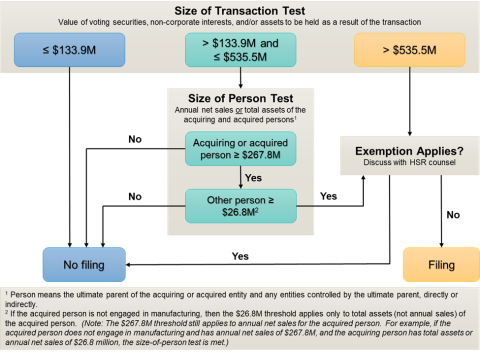
- The size-of-transaction test is met if the value of voting securities, noncorporate interests, assets, or a combination thereof held as a result of the transaction is in excess of $133.9 million (increased from $126.4 million).
- The size-of-person test is met if the ultimate parent entity of one of the parties to the transaction has $26.8 million (increased from $25.3 million) or more in total assets or annual net sales, and the ultimate parent entity of the other party to the transaction has $267.8 million (increased from $252.9 million) or more in total assets or annual net sales.
- The size-of-person test does not apply if the transaction is valued in excess of $535.5 million (increased from $505.8 million).
Below is a summary of the changes to the jurisdictional thresholds and an HSR analysis decision tree with the new thresholds:
| Jurisdictional Tests and Thresholds | |||
|---|---|---|---|
Original (FY 2003 base year) | Current (effective until February 17, 2026) | New (effective on and after February 17, 2026) | |
Minimum size-of-transaction threshold (size-of-person test must be met) | > $50 million | > $126.4 million | > $133.9 million |
| Lower size-of-person threshold | ≥ $10 million | ≥ $25.3 million | ≥ $26.8 million |
| Higher size-of-person threshold | ≥ $100 million | ≥ $252.9 million | ≥ $267.8 million |
| Large size-of-transaction threshold (size-of-person test is not applicable) | > $200 million | > $505.8 million | > $535.5 million |
Revised Notification Thresholds
Section 802.21 of the HSR rules exempts the acquisition of voting securities of a corporation for five years after the expiration or termination of the waiting period of a prior HSR filing if the acquiring person meets all of the following requirements:
- It completed the acquisition that was the subject of the filing within one year of the expiration or termination of the waiting period.
- It crossed the applicable notification threshold within one year of the expiration or termination of the waiting period.
- It will not meet or exceed the next notification threshold as a result of acquiring additional shares of voting securities.
Below are the original, current, and new notification thresholds for purposes of the Section 802.21 exemption, which will become effective for transactions closing on or after February 17, 2026:
| Notification Thresholds | ||
|---|---|---|
Original (FY 2003 base year) | Current (effective until February 17, 2026) | New (effective on and after February 17, 2026) |
| > $50 million | > $126.4 million | > $133.9 million |
| ≥ $100 million | ≥ $252.9 million | ≥ $267.8 million |
| ≥ $500 million | ≥ $1.264 billion | ≥ $1.339 billion |
| ≥ 25% if > $1 billion | ≥ 25% if > $2.529 billion | ≥ 25% if > $2.678 billion |
| ≥ 50% if > $50 million | ≥ 50% if > $126.4 million | ≥ 50% if > $133.9 million |
Revised Filing Fee Schedule
Pursuant to the Merger Filing Fee Modernization Act of 2022, the FTC is required to annually (1) adjust the filing fee tiers to reflect the percentage change in GNP for the prior fiscal year compared to the fiscal year that ended on September 30, 2022, and (2) increase the filing fee amounts annually by the Consumer Price Index (CPI) for the prior fiscal year compared to the fiscal year that ended on September 30, 2022, if the percentage increase is greater than 1%.
The current and new filing fee schedules are provided below:
| Filing Fee | Tiers (Size-of-Transaction) | ||
|---|---|---|---|
| Current | New | Current | New |
| $30,000 | $35,000 | Greater than $126.4 million but less than $179.4 million | Greater than $133.9 million but less than $189.6 million |
| $105,000 | $110,000 | $179.4 million or greater but less than $555.5 million | $189.6 million or greater but less than $586.9 million |
| $265,000 | $275,000 | $555.5 million or greater but less than $1.111 billion | $586.9 million or greater but less than $1.174 billion |
| $425,000 | $440,000 | $1.111 billion or greater but less than $2.222 billion | $1.174 billion or greater but less than $2.347 billion |
| $850,000 | $875,000 | $2.222 billion or greater but less than $5.555 billion | $2.347 billion or greater but less than $5.869 billion |
| $2,390,000 | $2,460,000 | $5.555 billion or greater | $5.869 billion or greater |
Civil Penalty
The maximum civil penalty amount for violations of the HSR Act is expected to increase from $53,088 to $54,540 per day. The Federal Civil Penalties Inflation Adjustment Act Improvements Act of 2015 requires the FTC to adjust its maximum civil penalties pursuant to a cost-of-living adjustment. Although the daily fee may not appear astronomical, it is easy to see how the fee could quickly become significant if a violation remains unfixed for weeks or even months.
Federal Antitrust Agencies Actively Enforce Nonreportable Transactions
Parties should also keep in mind that just because a transaction is not reportable under the HSR Act does not mean that it is exempt from agency scrutiny of the potential anticompetitive effects of the transaction. The FTC, DOJ, and state attorneys general (as well as private parties) may challenge a transaction as anticompetitive even when no HSR filing is required for the transaction and even after a transaction is consummated. Therefore, all transactions should be reviewed for antitrust compliance prior to closing.
Impact on Notification Requirements for States Enacting the Uniform Antitrust Pre-Merger Notification Act
In 2025, Washington and Colorado, respectively, became the first two states to enact a variation of the Uniform Antitrust Pre-Merger Notification Act, which is model legislation proposed by the Uniform Law Commission to provide a mechanism for state attorneys general to receive a copy of the HSR filing at the same time as the federal antitrust agencies.
The Uniform Antitrust Pre-Merger Notification Act applies where a party (1) submitted a filing to the DOJ and FTC under the HSR Act and (2) either one of the following thresholds apply:
- The filing person has a principal place of business in the state; or
- The filing person directly or indirectly had annual net sales in the state of the goods or services involved in the transaction of at least 20% of the initial size-of-transaction threshold (i.e., the $50 million (as adjusted) threshold).
When the new HSR thresholds become effective, the annual net sales threshold under the Uniform Antitrust Pre-Merger Notification Act will increase from $25.28 million to $26.78 million.
The Uniform Antitrust Pre-Merger Notification Act is only a notification statute. It does not establish a separate waiting period at the state level or otherwise allow the state attorney general to pause or block a transaction outside of seeking an injunction in federal or state court.
The District of Columbia and several state legislatures, including California, Hawaii, Indiana, Nevada, Utah, and West Virginia, have introduced legislation to adopt a variation of the Uniform Antitrust Pre-Merger Notification Act. New York is also considering legislation that would require any person notifying the federal agencies under the HSR Act to provide the attorney general with a copy of the HSR filing if that person conducts any business in New York.
Several states have enacted sector-specific pre-transaction notification and waiting requirements, primarily involving healthcare transactions.
Revised Section 8 Thresholds
As required by statute, the FTC published its annual revisions to the interlocking directorate thresholds under Section 8 of the Clayton Act, effective as of January 16, 2026. Section 8 prohibits a “person” from serving as a director or officer of two competing corporations if each has capital, surplus, and undivided profits of more than $54,402,000 (increased from $51,380,000) unless one of the following de minimis exemptions is met:
- The competitive sales of either corporation are less than $5,440,200 (increased from $5,138,000).
- The competitive sales of either corporation are less than 2% of its total sales.
- The competitive sales of each corporation are less than 4% of its total sales.
Print and share
Authors

Notice
Before proceeding, please note: If you are not a current client of Perkins Coie, please do not include any information in this e-mail that you or someone else considers to be of a confidential or secret nature. Perkins Coie has no duty to keep confidential any of the information you provide. Neither the transmission nor receipt of your information is considered a request for legal advice, securing or retaining a lawyer. An attorney-client relationship with Perkins Coie or any lawyer at Perkins Coie is not established until and unless Perkins Coie agrees to such a relationship as memorialized in a separate writing.

Notice
Before proceeding, please note: If you are not a current client of Perkins Coie, please do not include any information in this e-mail that you or someone else considers to be of a confidential or secret nature. Perkins Coie has no duty to keep confidential any of the information you provide. Neither the transmission nor receipt of your information is considered a request for legal advice, securing or retaining a lawyer. An attorney-client relationship with Perkins Coie or any lawyer at Perkins Coie is not established until and unless Perkins Coie agrees to such a relationship as memorialized in a separate writing.

Notice
Before proceeding, please note: If you are not a current client of Perkins Coie, please do not include any information in this e-mail that you or someone else considers to be of a confidential or secret nature. Perkins Coie has no duty to keep confidential any of the information you provide. Neither the transmission nor receipt of your information is considered a request for legal advice, securing or retaining a lawyer. An attorney-client relationship with Perkins Coie or any lawyer at Perkins Coie is not established until and unless Perkins Coie agrees to such a relationship as memorialized in a separate writing.