Race to the Seabed: NOAA Digs Deeper With Combined Permitting for Mineral Exploration and Recovery in International Waters

On January 21, 2026, the National Oceanic and Atmospheric Administration (NOAA) published a final rule revising its regulations governing deep seabed mining under the Deep Seabed Hard Mineral Resources Act of 1980 (DSHMRA).[1]
The rule modernizes NOAA’s regulatory framework for U.S. entities seeking to explore for and commercially recover hard mineral resources in areas beyond national jurisdiction (ABNJ).[2] For industry participants, the rule introduces an optional consolidated application process intended to streamline regulatory review while maintaining existing statutory, environmental, and procedural requirements. While this accelerated process could deliver short-term benefits to applicants for these licenses and permits, risks remain due to an untested process, significant opposition to the technology, and a divergence in international governance over projects to be sited in areas beyond national jurisdiction.
Background
Interest in deep seabed minerals has increased amid global demand for critical minerals used in energy storage, electrification, and advanced manufacturing supply chains.[3]
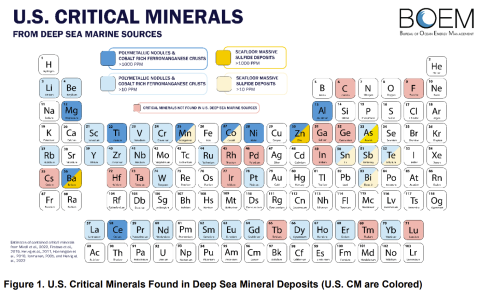
On April 25, 2025, the White House issued Executive Order 14285, directing federal agencies to promote responsible development of offshore and seabed mineral resources, including through regulatory efficiency and interagency coordination.[4] NOAA’s final rule modernizes procedural mechanisms under existing statutory authority rather than revising substantive standards. At the same time, scientific researchers question the adequacy of information on the ecological characteristics of deep-sea environments and adverse environmental impacts associated with seabed activities.
DSHMRA authorizes NOAA to issue exploration licenses and commercial recovery permits for deep seabed hard mineral resources, including polymetallic nodules and other mineral deposits located in ABNJ.[5]
- Exploration license. This authorizes a U.S. company to conduct surveys, research, and test mining of polymetallic nodules in specified ABNJ.
- Commercial recovery permit. This authorizes an eligible U.S. company to conduct recovery of polymetallic nodules in specified ABNJ for marketing or commercial purposes.
In 2025, NOAA received and began reviewing exploration license applications under DSHMRA, signaling a shift from dormant regulatory authority toward active implementation.[6] The U.S. regulatory framework under DSHMRA was enacted in anticipation of international seabed mining governance mechanisms; NOAA’s authority and obligations are defined by U.S. law, which disclaims any sovereign or exclusive rights or jurisdiction over any areas or resources in the deep seabed.[7]
Updated Framework: Key Provisions
Optional Consolidated Application Process
The final rule establishes an optional consolidated process allowing applicants to submit a single application addressing both an exploration license and a commercial recovery permit.[8] Under prior regulations, applicants generally proceeded through these stages sequentially.[9]
The consolidated process is intended for applicants that have developed sufficient technical, environmental, and financial information to support review of both phases concurrently. NOAA emphasized that consolidation is procedural and does not alter statutory eligibility requirements or substantive review standards.[10]
Continued Availability of Sequential Applications
Applicants may continue to pursue exploration licenses and commercial recovery permits separately. NOAA retained this pathway to accommodate projects at varying stages of development and to allow applicants to manage regulatory, technical, and investment risk incrementally.[11]
Conforming and Technical Amendments
To support the consolidated process, NOAA revised provisions across its exploration and commercial recovery regulations. These amendments address application timing, fee submission, revisions to existing licenses or permits, diligence requirements, and public availability of application materials.[12]
Environmental Review Requirements
The rule reaffirms that all applications remain subject to environmental review under the National Environmental Policy Act (NEPA) and other applicable statutes. Applicants must prepare environmental impact statements, monitoring plans, and mitigation strategies to avoid significant adverse effects on the quality of the human environment. NOAA will require consultations under the Endangered Species Act, Marine Mammal Protection Act, and Coastal Zone Management Act. The agency is separately updating its Deep Seabed Mining Final Technical Guidance Document to establish data acquisition standards for environmental monitoring, with a draft expected for public review in 2026.
Key Takeaways for Industry
- Immediate effect. The final rule is effective immediately upon publication under the Administrative Procedure Act exception for rules that relieve restrictions. Applicants can begin utilizing the consolidated application process right away.[13]
- Strategic opportunity for qualified entities. U.S. companies with substantial financial resources, proven technical capabilities, and access to relevant environmental and geological data may significantly accelerate their path to commercial seabed mining by utilizing the consolidated application procedure. Early movers may gain competitive advantages in securing priority rights to high-value mining areas.
- Strategic flexibility for applicants. Applicants may choose between consolidated and sequential approaches based on project maturity, data availability, and risk management priorities.
- Environmental and technical readiness remain central. Demonstrated environmental baseline data and technical capability continue to be core components of NOAA’s review.
- Due diligence to minimize risk. Developers and investors should ensure that funded projects include comprehensive environmental baseline data adequate for NEPA review. Projects lacking clear environmental documentation may face extended regulatory review cycles, even under the consolidated process. Timelines for review of applications are at the discretion of the agency but subject to a one-year environmental impact assessment process once the agency certifies an application.[14] The failure to meet permitting milestones can materially affect valuation, offtake negotiations, and financing covenants.[15] There also are the separate risks of moving too quickly, particularly given the controversy over jurisdiction,[16] an untested application process, and significant opposition from the environmental, oceans, and Indigenous communities, more than 40 countries, and even global companies.[17] Accelerated permitting does not guarantee success and, in fact, could lead to increased project risk. Litigation remains a significant concern, as with any infrastructure project and, in particular, a nascent technology with unknown effects.[18]
- Community engagement remains critical. Involving local and Indigenous communities through active engagement, education, and transparent environmental review and decision processes are more likely to result in a successful project.
- Leverage agency expertise and request pre-consultation. Applicants should work closely with NOAA, BOEM, and other federal agencies to leverage their expertise in deep-ocean science technologies and comprehensive, interdisciplinary, and systematic studies to understand baseline environmental conditions[19] and take advantage of pre-consultation opportunities encouraged by NOAA.[20]
- Capital allocation and permit timing. Permit milestones can materially affect valuation, offtake negotiations, and financing covenants.
- International vs. domestic regulatory exposure. While domestic NOAA regulations provide a clear path under U.S. law, investors should consider the potential impacts of evolving international governance on long-term project viability and social license to operate.
Conclusion
NOAA's final rule represents a watershed moment for U.S. deep seabed mining policy, providing qualified entities with an accelerated regulatory pathway to access critical mineral resources in international waters. The consolidated application process aligns with the Trump administration's emphasis on resource independence and streamlined permitting, while maintaining statutory environmental safeguards. Companies interested in seabed mineral exploration and recovery should carefully evaluate whether they meet the qualification standards for consolidated applications and consider engaging in recommended pre-application consultations and leveraging existing federal agency datasets. Given the significant capital requirements, technical complexity, and international dimensions of seabed mining, entities should assemble multidisciplinary teams encompassing legal, environmental, technical, and financial capabilities to navigate this evolving regulatory landscape.
Endnotes
[1] Deep Seabed Mining: Revisions to Regulations for Exploration License and Commercial Recovery Permit Applications, 91 Fed. Reg. 2642 (Jan. 21, 2026) (to be codified at 15 C.F.R. pts. 970–971).
[2] This alert does not address the jurisdiction of the Bureau of Ocean Energy Management (BOEM) to lease and permit projects on the Outer Continental Shelf Lands Act. See 3 U.S.C. §§ 1331 et seq.; 30 C.F.R. Part 581.
[3] See Linda R. Rowan, Cong. Rsch. Serv., R47982, Critical Mineral Resources: National Policy and Critical Minerals List (2025).
[4] Trump Administration Makes Move to Expand Critical Mineral Production Through Deep-Sea Mining (Apr. 25, 2025). Caitlin Keating-Bitonti, Cong. Rsch. Serv., IF12608, U.S. Interest in Seabed Mining in Areas Beyond National Jurisdiction: Brief Background and Recent Developments (2025).
[5] 30 U.S.C. §§ 1411–1413. For more detail on jurisdiction over deep seabed mining exploration and development in both U.S. and international waters, please see our Updates: The Latest in the Race for Deep-Sea Minerals (Nov. 4, 2025); BOEM Rapidly Advances Steps to Develop Critical Minerals in American Samoa and Commonwealth of Mariana Islands (Nov. 19, 2025).
[6] Critical Minerals at a Critical Point: NOAA’s Decision Point (Jan. 16, 2025).
[8] 91 Fed. Reg. at 2642–43, 2651–52 (codified in 15 C.F.R. §§ 970.200–.214; 971.200–.214).
[13] Upon the rules publication, The Metals Company USA immediately announced that it had submitted a consolidated application under the new process. According to TMC USA, “[t]he consolidated application covers areas previously applied over in April 2025 and increases the commercial recovery area from ~25,000 to ~65,000 km2, with an estimated resource of 619 million tonnes (Mt) of wet nodules and a potential exploration upside of an additional 200 Mt.”
[14] 91 Fed. Reg. at 2642 (to be codified at 15 C.F.R. § 971.214(e)).
[15] 30 U.S.C. § 1419(d) (“Each draft environmental impact statement prepared pursuant to this subsection shall be published, with the terms, conditions, and restrictions proposed pursuant to section 1415(b) of this title, within 180 days (or such longer period as the Administrator may establish for good cause shown in writing) following the date on which the application for the license or permit concerned is certified by the Administrator. Each final environmental impact statement shall be published 180 days (or such longer period as the Administrator may establish for good cause shown in writing) following the date on which the draft environmental impact statement is published.”).
[16] In a statement following the issuance of Executive Order 14285 and subsequent submission of The Metals Company of exploration licenses to NOAA, Secretary General Leticia Carvalho of the International Seabed Authority stated that Executive Order 14285 was “surprising because for over 30 years the US has been a reliable observer and significant contributor to the negotiations of the International Seabed Authority.” She further stated that “any unilateral action to mine the deep sea sets a dangerous precedent that could destabilize the entire system of global ocean governance” and “would constitute a violation of international law and directly undermine principles of multilateralism, the peaceful use of oceans and the collective governance framework established under UNCLOS.” Id.
[17] See Critical Minerals at a Critical Point: NOAA’s Decision Point. See also Deep-Sea Mining Moratorium, Voices calling for a moratorium, 70 companies have signed the business statement calling for a moratorium on deep seabed mining activities to date. Note that on January 22, 2026, in addition to witnesses’ diverging perspectives, bipartisan concerns were voiced regarding the ecological, cultural, and economic impacts of deep-sea mining during a hearing on the regulatory and statutory barriers to deep sea mining held by the House Committee on Natural Resources.
[18] DSHMRA establishes a private right of action for parties with standing to sue to seek equitable relief against either the NOAA administrator for failing to perform a nondiscretionary duty or any person violating the act or related licenses or permits. 30 U.S.C. § 1427(a).
[19] Nat’l Oceanic & Atmospheric Admin., State of the Science Fact Sheet: Deep Sea Mining (Jan. 2025).
[20] Requests for pre-application consultations can be submitted to nos.dshmra@noaa.gov.
Print and share
Authors

Notice
Before proceeding, please note: If you are not a current client of Perkins Coie, please do not include any information in this e-mail that you or someone else considers to be of a confidential or secret nature. Perkins Coie has no duty to keep confidential any of the information you provide. Neither the transmission nor receipt of your information is considered a request for legal advice, securing or retaining a lawyer. An attorney-client relationship with Perkins Coie or any lawyer at Perkins Coie is not established until and unless Perkins Coie agrees to such a relationship as memorialized in a separate writing.

Notice
Before proceeding, please note: If you are not a current client of Perkins Coie, please do not include any information in this e-mail that you or someone else considers to be of a confidential or secret nature. Perkins Coie has no duty to keep confidential any of the information you provide. Neither the transmission nor receipt of your information is considered a request for legal advice, securing or retaining a lawyer. An attorney-client relationship with Perkins Coie or any lawyer at Perkins Coie is not established until and unless Perkins Coie agrees to such a relationship as memorialized in a separate writing.
Explore more in
Topics
Related insights
Regulatory Roundup: Navigating a New Era
Regulatory Roundup shares timely insights into significant policy changes under the new administration, breaking down complex regulations into clear, actionable information.