The Latest in the Race for Deep-Sea Minerals

On October 28, 2025, the National Oceanic and Atmospheric Administration (NOAA) sent a draft rule to the Office of Management and Budget’s Office of Information and Regulatory Affairs that would streamline the NOAA permitting process for deep-sea mining.
The draft rule proposes updates to the regulations implementing the Deep Seabed Hard Mineral Resources Act (DSHRMA), which provides the U.S. regulatory framework for deep-sea mining. The move represents the latest step by the Trump administration, through its April 24, 2025, executive order, to prioritize U.S. leadership in seabed mapping and mineral exploration to ensure reliable access to critical minerals like manganese, nickel, cobalt, and rare earth elements.
Legal Authority for Deep-Sea Mining
The International Seabed Authority oversees deep-seabed mining activities in areas outside national jurisdiction for countries that are parties to the United Nations Convention on the Law of the Sea (UNCLOS). The United States has recognized UNCLOS as customary international law but is not an UNCLOS party.
On April 24, 2025, the Trump administration issued Executive Order 14285 aimed at fast-tracking deep-sea mining. Executive Order 14285 provides for stockpiling deep-sea metals to counter China’s dominance in the supply chain.
Under the DSHRMA, NOAA, within the Department of Commerce, reviews applications and issues exploration licenses and commercial recovery permits to U.S. entities for seabed minerals in international waters. The Outer Continental Shelf Lands Act (OCSLA) governs mineral exploration and development on the U.S. Outer Continental Shelf (OCS).[1] The Bureau of Ocean Management (BOEM), within the Department of the Interior (DOI), administers mineral leasing on the OCS. Under BOEM’s existing regulations, any person, entity, or company can request that OCS marine minerals be offered for lease.[2]
NOAA’s Proposed Regulatory Changes to Deep-Seabed Mining Exploration and Commercial Recovery Role in Deep-Sea Mining
On July 7, 2025, NOAA proposed changes to its regulations governing deep-seabed mining[3] under the DSHRMA.[4] These proposed changes are in direct response to Executive Order 14285.[5] The bulk of the revised rule centers on consolidating the licensing and permitting procedure, enabling qualified U.S. applicants to apply simultaneously for both an exploration license and commercial recovery permit. NOAA would then conduct a single, comprehensive review of the application, including preparing an Environmental Impact Statement covering both exploration and commercial recovery activities. NOAA would issue separate but simultaneous decisions on the license and permit. This is different from the existing framework, where U.S. applicants must first obtain an exploration license and only later apply separately for a commercial recovery permit.[6] The proposed change will streamline the process by allowing for a single, integrated application and review. The length of the exploration license (10 years) and the commercial recovery permit (20 years) would not change or affect the ability to extend the permit.
The proposed changes are intended to reflect the progress in technological capability and scientific knowledge surrounding deep-sea mining. U.S. applicants applying under the proposed changes must demonstrate their past exploration activities and provide a statement of technological experience and capabilities.
DOI’s Policy Changes to Speed Up the Search and Development of Critical Minerals
On February 3, 2025, the Secretary of the Interior directed all DOI bureaus and offices to identify authorities to facilitate identification, permitting, and leasing of critical minerals on federal lands.[7] In response to Executive Order 14285, the DOI announced new policy steps on June 25, 2025, to expedite the search and development of critical minerals offshore. BOEM and the Bureau of Safety and Environmental Enforcement (BSEE) are updating policies across all stages of development to reduce delays, improve coordination, and provide greater certainty for industry entities. According to the DOI announcement, this will include earlier identification of potential areas on the OCS for development right away, without first issuing a formal request for information or forming a joint task force with state and federal agencies. Once a lease is issued, BOEM will continue to streamline the process by considering offshore critical mineral projects for expedited permitting under the DOI’s emergency procedures and other applicable laws.
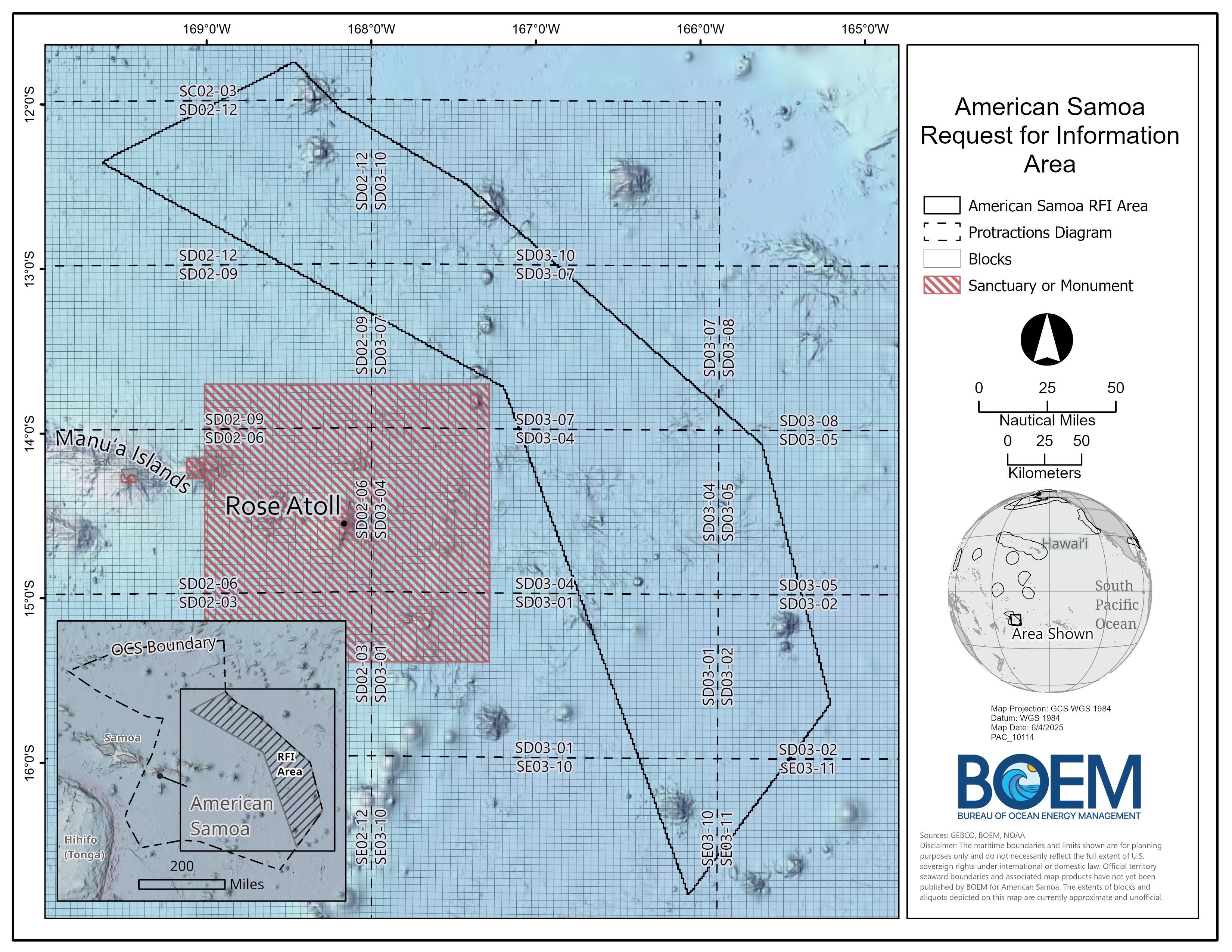
At the same time BOEM and BSEE are developing these policies, BOEM is analyzing comments submitted in response to a Request for Information and Interest (RFI) for commercial leasing for OCS seabed critical minerals offshore American Samoa.[8] The RFI was published in response to an April 8, 2025, unsolicited request for a lease sale from U.S.-based company Impossible Metals, and centers around the area located near the eastern limit of the American Samoa OCS bordering the Cook Islands Exclusive Economic Zone, northeast of the Manu’a Island and Rose Atoll. The area is approximately 18.1 million acres. Eventually, BOEM and the DOI will identify specific lease areas and publish a Notice for Commercial Leasing in the Federal Register.
Key Takeaways
Executive Order 14285 initiated an aggressive use of U.S. authorities that are now taking off. What remains to be answered is how these developments conflict with the evolving international system for management of the deep sea. While the United States has respected the Law of the Sea treaty as customary international law and even negotiated an agreement for the conservation of biological diversity in areas beyond national jurisdiction, the April executive order and NOAA and BOEM’s regulatory updates represent a shift in U.S. foreign and domestic policy towards the development of a competitive regime for permitting exploitation of deep-sea mineral deposits. This evolving regulatory regime is the latest response in the race to develop critical minerals.
[1]43 U.S.C. §§ 1331 et seq.
[2]See generally 30 C.F.R. Part 581.
[3] Deep Seabed Mining Regulations for Exploration Licenses, 15 C.F.R. Part 970.
[4] Deep Seabed Mining: Revisions to Regulations for Exploration License and Commercial Recovery Permit Applications, 90 Fed. Reg. 29806 (July 7, 2025).
[5] In response to Executive Order 14285, the Metals Company submitted an application for a commercial recovery permit and two exploration licenses under the DSHMRA and NOAA’s implementing regulations. See The Metals Company, World First: TMC USA Submits Application for Commercial Recovery of Deep-Sea Minerals in the High Seas Under U.S. Seabed Mining Code (April 29, 2025), https://investors.metals.co/news-releases/news-release-details/world-first-tmc-usa-submits-application-commercial-recovery-deep
[6] 15 C.F.R. Parts 970 and 971.
[7] Secretarial Order 3417, Addressing the National Energy Emergency (Feb. 3, 2025).
[8] Commercial Leasing for Outer Continental Shelf Minerals Offshore American Samoa—Request for Information and Interest, 90 Fed. Reg. 25369 (June 16, 2025). Given DOI issued an RFI in this case but shortly thereafter stated that it would not issue RFIs for leasing, it is uncertain where the leasing process will land.
Print and share
Authors

Notice
Before proceeding, please note: If you are not a current client of Perkins Coie, please do not include any information in this e-mail that you or someone else considers to be of a confidential or secret nature. Perkins Coie has no duty to keep confidential any of the information you provide. Neither the transmission nor receipt of your information is considered a request for legal advice, securing or retaining a lawyer. An attorney-client relationship with Perkins Coie or any lawyer at Perkins Coie is not established until and unless Perkins Coie agrees to such a relationship as memorialized in a separate writing.

Notice
Before proceeding, please note: If you are not a current client of Perkins Coie, please do not include any information in this e-mail that you or someone else considers to be of a confidential or secret nature. Perkins Coie has no duty to keep confidential any of the information you provide. Neither the transmission nor receipt of your information is considered a request for legal advice, securing or retaining a lawyer. An attorney-client relationship with Perkins Coie or any lawyer at Perkins Coie is not established until and unless Perkins Coie agrees to such a relationship as memorialized in a separate writing.

Notice
Before proceeding, please note: If you are not a current client of Perkins Coie, please do not include any information in this e-mail that you or someone else considers to be of a confidential or secret nature. Perkins Coie has no duty to keep confidential any of the information you provide. Neither the transmission nor receipt of your information is considered a request for legal advice, securing or retaining a lawyer. An attorney-client relationship with Perkins Coie or any lawyer at Perkins Coie is not established until and unless Perkins Coie agrees to such a relationship as memorialized in a separate writing.
Explore more in
Topics
Regulatory Roundup: Navigating a New Era
Regulatory Roundup shares timely insights into significant policy changes under the new administration, breaking down complex regulations into clear, actionable information.