Federal Offshore Critical Minerals Leasing Gains Momentum Near CNMI

Key Takeaways
- On March 18, 2026, the Bureau of Ocean Energy Management (BOEM) issued an Area Identification Recommendation (Area ID) covering more than 69 million acres offshore of the Commonwealth of the Northern Mariana Islands (CNMI).
- The Area ID advances the administration's objectives under Executive Order 14285 to prioritize U.S. leadership in seabed mineral exploration and ensure reliable access to critical minerals.
- The Area ID recommendation nearly doubles the original RFI Area, expanding from approximately 35.5 million acres to approximately 69.1 million acres.
- The Area ID does not commit BOEM to leasing; the next step is to conduct an environmental analysis in advance of any lease sale.
- BOEM received more than 1,600 unique comments reflecting significant opposition from government officials, indigenous communities, and environmental groups citing ecological, cultural, and fisheries concerns.
- Companies interested in a potential lease sale should begin preparing their technical and financial capabilities and seek legal counsel to navigate significant regulatory complexity and opposition.
On March 18, 2026, the Bureau of Ocean Energy Management announced the Area Identification Recommendation for potential commercial leasing of critical minerals[1] in more than 69 million acres offshore the Commonwealth of the Northern Mariana Islands.[2] The Area ID decision represents a critical milestone in BOEM's Outer Continental Shelf (OCS) leasing process, advancing the area from an initial information-gathering stage to active consideration for a potential lease sale and environmental analysis.[3] This announcement also furthers the administration’s objectives to prioritize U.S. leadership in seabed mapping and mineral exploration to ensure reliable access to critical minerals set forth in President Trump’s Executive Order 14285, “Unleashing America's Offshore Critical Minerals and Resources.”[4]
Background
BOEM commenced the leasing process for critical minerals offshore CNMI on November 12, 2025, with a Request for Information and Interest (RFI).[5] The area identified in the RFI (RFI Area) is located east of the Mariana Trench National Monument, along the eastern edge of the U.S. Exclusive Economic Zone (EEZ). The RFI Area encompasses approximately 35.5 million acres.
On December 12, 2025, BOEM extended the comment period until January 12, 2026, in response to a request from the governors of the CNMI and Guam.
Area ID Recommendation: Significant Expansion From the RFI Area
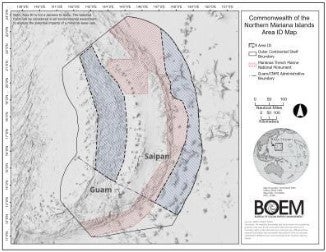
The Area ID recommendation for the CNMI includes two geographically distinct areas. Notably, the Area ID recommendation nearly doubles the scope of the original RFI Area, expanding from approximately 35.5 million acres to approximately 69.1 million acres. This expansion is the result of industry interest in areas west of the CNMI for polymetallic sulfide development—new areas that were not included in the original RFI.
As described in the Area ID Memorandum, the recommended area includes two geographically distinct areas, one east of the CNMI and one west of the CNMI. The area located east of the CNMI and the Mariana Trench National Marine Monument comprises almost 36 million acres, and is located 128 miles from Saipan and 127 miles from Guam at its closest point. This area is consistent with indications of interest and the prospective seabed mineral regions identified by the U.S. Geological Survey (USGS) in and around the RFI Area for ferromanganese crusts and polymetallic nodules.[6] The area located west of the CNMI comprises almost 34 million acres (6,248 whole or partial blocks) and is located 57 miles from Saipan and 46 miles from Guam at its closest point. The identification of this area arises from industry interest in polymetallic sulfides, though no field work has been conducted expressly for locating these deposits.[7] In both areas, the primary minerals for commercial development include potential commercially viable quantities of cobalt, nickel, copper, manganese, zinc, rare earth elements, and other minerals that could be viably extracted and processed in the future.
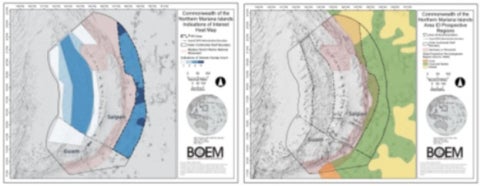
In making its recommendation, BOEM considered available OCS mineral resources, environmental data, and information and interest when considering whether to proceed with the next steps leading to a potential OCS mineral lease. More than 1,600 unique comments (of more than 60,000 total) were submitted with a wide range of support and concerns, including government officials, industry, indigenous communities, and environmental groups. These comments are summarized in the Area ID memorandum.
Comments of note include a letter from the CNMI Governor David M. Apatang. His letter stated that he will neither fully support nor oppose advancing seabed mining activities based on information in the RFI. He requested that prior to any leasing decisions, the following be provided: (1) comprehensive scientific data and baseline environmental information; (2) a full Environmental Impact Statement (EIS); (3) clear economic benefit pathways; and (4) meaningful government-to-government and community engagement.
Governor of Guam, Lourdes A. Leon Guerrero, Lieutenant Governor Josh Tenorio, and other top government leaders submitted several letters stating joint opposition to the proposed commercial leasing offshore the CNMI. They requested a halt to the leasing process and that BOEM must include Guam in further discussions and decisions.[8] Additionally, they requested a regional EIS and sufficient scientific research and analysis of the environmental, ecological, economic, and marine life impacts of seabed mining. The Guam Legislature also submitted Resolution No. 132-38, which reaffirms Guam’s moratorium on deep-sea mining and opposes BOEM’s offshore mineral leasing proposal near the CNMI.
Other comments on the RFI raised the following categories of issues:
- Environmental concerns. Many commenters expressed significant concern about irreversible damage to deep-sea ecosystems, highlighting potential threats to marine food webs, endangered species, coral reefs, fisheries, noise and light pollution, and toxic releases associated with mining activities.
- Cultural and Indigenous rights concerns. Many commenters called for respect for Indigenous rights and sovereignty in decision-making about ocean resources, emphasizing the deep cultural, spiritual, and ancestral connections of the Chamorro and Carolinian peoples to the ocean surrounding the Mariana Islands. Commenters also requested meaningful consultation with Indigenous communities and incorporation of revenue-sharing with local communities.
- Socioeconomic concerns. Commenters raised concerns about impacts to commercial and subsistence fisheries, including threatening commercially important fish species and the $5.5 billion Pacific tuna industry.
- Lease structure comments. Industry commenters expressed support for BOEM's proposal not to charge rent during the first five years of leases and suggested that royalty rates should be no higher than 3%, reduced to 1.5% for the first five years.
- National security and economy. Commenters stated that leasing in the proposed area could mitigate national security risks, provide large quantities of critical minerals and revenue for the U.S. Treasury, and support ocean resource economy initiatives.
Key Takeaways and Next Steps
This Area ID comes on the heels of BOEM’s proposed revisions to regulations governing hard mineral resources on the OCS. This includes the proposed elimination of 30 C.F.R § 580.31, which requires the BOEM director to notify adjacent or affected state governors and local governments and organizations about environmental issues related only to mineral prospecting.[9] Concerns have already been raised about the removal of that notification requirement.[10]
Importantly, the Area ID does not commit BOEM to leasing. Instead, the next step in BOEM’s leasing process is to conduct an environmental analysis in advance of a lease sale. The Area ID memorandum indicates that the environmental analysis that will be conducted before any lease sale decisions will “inform potential exclusions and best management practices that can be applied to leases issued in a potential CNMI OCS mineral lease sale.”[11] Additionally, the comments BOEM received for the RFI will inform the environmental review of preliminary activities permissible under a lease, which include bathymetric, geological, geophysical, mapping, and other surveys necessary to develop comprehensive delineation, testing, or mining plans.[12]
Conclusion
EO 14285 initiated an aggressive use by U.S. authorities to extract critical minerals from the seabed. The CNMI Area ID is just the latest in a series of moves by BOEM to implement the EO’s ambitious goals. This continues to represent a shift in U.S. foreign and domestic policy towards the development of a competitive regime for permitting the exploitation of deep-sea mineral deposits.
Stakeholders should closely monitor developments in the environmental review process and engage in BOEM's upcoming consultations and public comment opportunities. Companies interested in participating in a potential lease sale should begin preparing their technical and financial capabilities to meet BOEM's requirements. Given the significant capital requirements, regulatory complexity, and accelerated opposition to any development on the OCS, interested parties should seek the advice of legal counsel to navigate this evolving landscape.
Endnotes
[1] See BOEM Area Identification Recommendation for the Commonwealth of Northern Mariana Islands Outer Continental Shelf (OCS) Mineral Leasing Process. Critical minerals are defined as any minerals, elements, substances, or materials that are determined to be essential to the economic and national security of the United States, have a supply chain vulnerable to disruption, and play an essential role in manufacturing a product whose absence would significantly affect U.S. economic or national security. The U.S. Geological Survey issued its Final List of Critical Minerals on November 7, 2025. Section 7002 of the Energy Act of 2020 (Pub. L. No. 116-260, Division Z).
[2] The Outer Continental Shelf Lands Act (OCS Lands Act) governs mineral exploration and development on the OCS. Section 50251(b) of the Inflation Reduction Act of 2022 expanded the definition of the OCS under the OCS Lands Act to include submerged lands within the EEZ adjacent to U.S. territories and amended the OCS Lands Act by modifying the definition of “State” to include the Commonwealth of Puerto Rico, Guam, American Samoa, U.S. Virgin Islands, and the CNMI. BOEM administers mineral leasing on the OCS. Section 8(k) of the OCS Lands Act authorizes the secretary of the Interior to grant leases on the OCS to qualified persons offering the highest cash bonuses for minerals other than oil, gas, and sulfur on a competitive basis. 43 U.S.C. §1337(k). Under BOEM’s existing regulations, any person, entity, or company can request that OCS marine minerals be offered for lease. 30 CFR § 581.11. The first step in the process for issuing a commercial lease is the issuance of an RFI under 30 CFR § 585.12(a).
[3] The CNMI Area ID follows BOEM’s announcement of the Area ID for American Samoa. Our November 19, 2025, Update describes the American Samoa Area ID and relevant key takeaways.
[4] Our April 25, 2025, Update provides an overview of the executive order.
[5] Our November 19, 2025, Update provides a background on the CNMI RFI.
[6] Area ID Memorandum at 6.
[7] Id.
[8] The Guam Legislature submitted Resolution No. 132-38 (COR) which reaffirms a moratorium on deep-sea mining and opposes BOEM’s offshore mineral leasing proposal near the CNMI.
[9] Our March 4, 2026, Update provides an extensive analysis of BOEM’s proposed revisions to the regulations.
[10] Acting Governor of Guam Joshua Tenorio raised concerns about BOEM’s proposed change because it reduces consultation requirements with state and territorial governments. “GovGuam wary of feds limiting consultations, rushing deep-sea mining lease review,” Pacific Daily News, Feb. 25, 2026.
[11] Area ID Memorandum at 8.
[12] See 30 CFR §580.
Print and share
Authors

Notice
Before proceeding, please note: If you are not a current client of Perkins Coie, please do not include any information in this e-mail that you or someone else considers to be of a confidential or secret nature. Perkins Coie has no duty to keep confidential any of the information you provide. Neither the transmission nor receipt of your information is considered a request for legal advice, securing or retaining a lawyer. An attorney-client relationship with Perkins Coie or any lawyer at Perkins Coie is not established until and unless Perkins Coie agrees to such a relationship as memorialized in a separate writing.

Notice
Before proceeding, please note: If you are not a current client of Perkins Coie, please do not include any information in this e-mail that you or someone else considers to be of a confidential or secret nature. Perkins Coie has no duty to keep confidential any of the information you provide. Neither the transmission nor receipt of your information is considered a request for legal advice, securing or retaining a lawyer. An attorney-client relationship with Perkins Coie or any lawyer at Perkins Coie is not established until and unless Perkins Coie agrees to such a relationship as memorialized in a separate writing.

Notice
Before proceeding, please note: If you are not a current client of Perkins Coie, please do not include any information in this e-mail that you or someone else considers to be of a confidential or secret nature. Perkins Coie has no duty to keep confidential any of the information you provide. Neither the transmission nor receipt of your information is considered a request for legal advice, securing or retaining a lawyer. An attorney-client relationship with Perkins Coie or any lawyer at Perkins Coie is not established until and unless Perkins Coie agrees to such a relationship as memorialized in a separate writing.
Explore more in
Topics
Related insights
Regulatory Roundup: Navigating a New Era
Regulatory Roundup shares timely insights into significant policy changes under the new administration, breaking down complex regulations into clear, actionable information.