New Southwest Power Pool Rule Could Supercharge Industrial and Data Center Connections

Key Takeaways
- FERC recently accepted Southwest Power Pool’s revisions to its Open Access Transmission Tariff, establishing a new Provisional Load Process for transmission customers, effective August 4, 2025.
- Last month, SPP’s board approved Revision Request 696 to modify SPP’s tariff by creating a targeted 90‑day study-and-approval process for interconnecting high-impact large loads.
- Other markets have similarly pursued fast-track processes to add data centers and large loads to their systems.
Executive Summary
Two big policy changes since September could reshape how large loads plug into the Southwest Power Pool (SPP) grid. Earlier this month, the Federal Energy Regulatory Commission (FERC) signed off on SPP’s new Provisional Load Process, which would allow new loads to be studied even when there isn’t sufficient power generation to serve the facilities. In parallel, SPP’s board advanced a 90‑day fast-track study-and-approval process for high-impact large loads, which will now be filed with FERC.
FERC’s approval of the Provisional Load Process comes in response to a surge in large load additions across the SPP footprint—particularly data centers and industrial facilities—and the difficulty under existing processes for SPP to proceed with interconnection studies of such facilities. SPP has experienced a substantial increase in requested load additions, far outpacing its ability to study such requests. The Provisional Load Process offers a new framework that allows SPP to consider a transmission customer’s planned, but not yet existing, generation when studying a new facility.
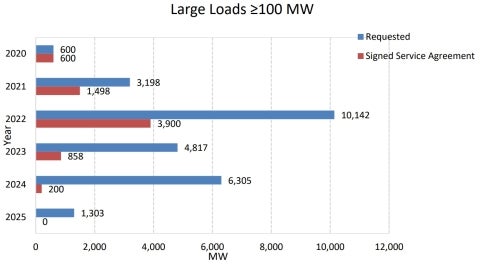
Southwest Power Pool (2025)
SPP Provisional Load Interconnection Review Process
On October 10, 2025, FERC accepted SPP’s revisions to its Open Access Transmission Tariff (Tariff) establishing a new Provisional Load Process for transmission customers, effective August 4, 2025.[1] Under the Provisional Load process, which is established in a new Attachment AX to the Tariff, SPP can evaluate requests for new load additions to SPP’s transmission system even when transmission customers lack sufficient existing power supplies to cover its 10-year load forecast, otherwise a requirement under SPP’s rules for load interconnection studies.
Prior to the approval of the Provisional Load Process, requests by transmission customers to add a new delivery point facility for load were processed under SPP’s Attachment AQ to the Tariff. Attachment AQ applies to delivery point changes for load served by the customer’s existing designated resources sufficient to serve a 10‑year load forecast (i.e., “normal growth” scenarios).[2] The lack of sufficient existing designated resources prevented SPP from processing the request under Attachment AQ.
The Provisional Load Process, or Attachment AX, creates a voluntary pathway for SPP to study new load additions using both existing designated resources and identified planned generation. The Provisional Load Process uses the same study process in Attachment AQ, except that it will consider planned generation, allowing a transmission customer to plan for how to serve its future load while SPP studies the reliability of and impacts on its transmission system.
Attachment AX operates as a study-only provisional pathway. Pursuant to the new pro forma Provisional Load Process agreements (Addenda 2 and 3 to Attachment AX), no transmission service or designation is provided until the transmission customer has Designated Resource Status for its planned generation, either through the Aggregate Transmission Service Study under Attachment Z1 (“Aggregate Transmission Service Study Procedures and Cost Allocation and Recovery for Service Upgrades”) of the Tariff or through the expedited process of section 30.2.2 (“Expedited Designation For Network Resource Deliverability”) of the Tariff. As a result, large loads must still carefully coordinate expected commercial operation of planned generation with deadlines for submitting into SPP’s study processes for transmission service or to designate a network resource. But the new provisional pathway provides earlier opportunities to evaluate cost and timing for interconnection.
Under the Provisional Load Process, the cost allocation of any necessary network upgrades needed to support the requested transmission service is initially assigned to the transmission customer. After the planned generation is included as a designated resource in the customer’s transmission service agreement, the remaining costs of the upgrades will be rolled into zonal or regional transmission rates.
SPP Advances New Policy To Fast-Track High-Impact Large Loads
The Provisional Load Process approval came on the heels of another major change in interconnection policy by SPP. On September 4, 2025, SPP’s board approved Revision Request 696 (RR 696) to modify SPP’s Tariff by creating a targeted 90‑day study-and-approval process for interconnecting high-impact large loads (HILLs). SPP intends the HILL policy to accelerate the interconnection of data centers, AI facilities, and other power‑intensive customers to the grid.
SPP defines a HILL as a “new commercial or industrial load, or increase in commercial or industrial load, at a single site connected through one or more shared points of interconnection or delivery points, where such load is either (1) 10 MW or more if connected to the transmission system at a voltage level less than or equal to 69 kV or (2) 50 MW or more if connected to the transmission system at a voltage greater than 69 kV."[3] Storage projects are excluded.
The framework establishes a coordinated study-and-approval process that integrates transmission service, generation and load interconnection, and reliability studies. As SPP explained, the HILL process “enables early detection of system constraints, improves coordination across entities and prepares operators for real-time impacts.” The new framework coordinates with existing Attachment AQ and Attachment AX processes, aiming to complete the HILL study within approximately 90 days.
A separate “HILL Generation Assessment” (HILLGA) would support HILLs paired with on‑site or nearby generation. HILLGA functions as a dedicated, HILL‑specific interconnection track that would be distinct from the Attachment AQ and Attachment AX study processes. In essence, the HILLGA process offers a third, expedited pathway to interconnection studies tailored toward new or existing generators that will support a HILL.
SPP must now file the proposal with FERC for approval. Development of the proposal was contentious among SPP stakeholders, and recent proposals by other regional transmission operators and independent system operators to fast-track some categories of generation over others have received intense scrutiny at FERC. Moreover, while FERC has continued operating amidst the current government shutdown using fund balances from last year, it has noted that it will cease accepting public filings once the balances run out. Even if SPP files before the shutdown begins to affect FERC operations, FERC closure could delay FERC’s consideration of SPP’s proposal.
Other Market Developments and Opportunities for Data Center Development
Other markets have similarly pursued fast-track processes to add data centers and large loads to their systems. In PJM, for example, the PJM board announced in August a stakeholder process known as the Critical Issue Fast Path initiative that aims to develop rules for interconnecting large loads, focusing on five main issues: resource adequacy, reliability criteria, interconnection rules, coordination, and timing. As with SPP, PJM forecasts a load growth of 32 GW from 2024 to 2030, with 30 GW projected to be from data centers. PJM aims to file with FERC the Critical Issue Fast Path by December of this year. In the meantime, PJM’s case regarding how the grid operator is allowed to treat large loads on its system that are co-located with power generation remains pending before FERC.
As data center demand continues to grow, there has been an increasing appetite for “powered land,” or land that has been secured, permitted, and primed to be ready for large load operations, such as data centers. Together with fast-track interconnection policies like those advanced in SPP and PJM, developers can continue to expect new policies and regulations in response to rapid load growth. Data center developers must stay tuned to these changes that, if properly utilized, can set their projects apart in regard to time to power.
Endnotes
[1] Southwest Power Pool, Inc., 193 FERC ¶ 61,018. See FERC Docket Nos. ER25-2430-000, ER25-2430-001.
[2] “Designated resources” are generation resources that a transmission customer has committed to serve its load on a noninterruptible basis, which must be in service and available to meet the customer’s network load.
[3] Southwest Power Pool, Inc., RR 696: Integrate and Operate High Impact Large Loads.
Print and share
Authors

Notice
Before proceeding, please note: If you are not a current client of Perkins Coie, please do not include any information in this e-mail that you or someone else considers to be of a confidential or secret nature. Perkins Coie has no duty to keep confidential any of the information you provide. Neither the transmission nor receipt of your information is considered a request for legal advice, securing or retaining a lawyer. An attorney-client relationship with Perkins Coie or any lawyer at Perkins Coie is not established until and unless Perkins Coie agrees to such a relationship as memorialized in a separate writing.

Notice
Before proceeding, please note: If you are not a current client of Perkins Coie, please do not include any information in this e-mail that you or someone else considers to be of a confidential or secret nature. Perkins Coie has no duty to keep confidential any of the information you provide. Neither the transmission nor receipt of your information is considered a request for legal advice, securing or retaining a lawyer. An attorney-client relationship with Perkins Coie or any lawyer at Perkins Coie is not established until and unless Perkins Coie agrees to such a relationship as memorialized in a separate writing.