FERC Orders PJM To Revise Tariff To Accommodate Co-Located Load Arrangement

Key Takeaways
- FERC ordered PJM to create new transmission service options for large co-located loads and to clarify interconnection rules.
- The order attempts to balance speed to power and reliable service for large loads with safeguards against shifting costs to other ratepayers.
- FERC asserted jurisdiction over large load interconnections to the PJM transmission grid, which may hint at broader action in its Co-Located Load Interconnection Rulemaking.
The Federal Energy Regulatory Commission (FERC) recently issued an order (the Order) in its PJM co-location docket, finding that PJM’s open access transmission tariff, operating agreement, and reliability assurance agreement (collectively the Tariff) are not just and reasonable because they do not sufficiently address the rates, terms, and conditions of service that apply to generators serving load that co-locates behind the generating facilities’ point(s) of interconnection with the grid (Co-Located Load).[1] FERC’s action evidences a new willingness to drive change in the PJM system in service to the administration’s aim to facilitate service to large data centers and other commercial and industrial loads that bring their own co-located generation to the table. Yet, FERC balanced this effort with safeguards for grid reliability and other ratepayers.
FERC’s Findings
The Order is far-reaching, but FERC focused on the following reforms to PJM’s Tariff:
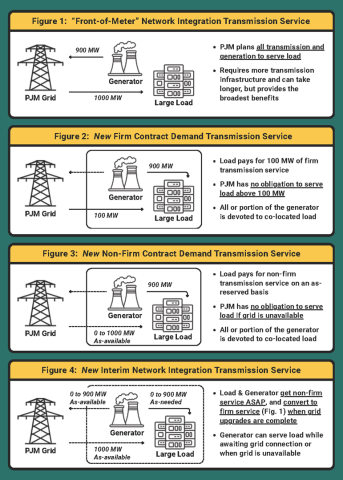
The order directs PJM to establish four types of transmission service available to an eligible transmission customer taking service on behalf of a Co-Located Load. The first type of service is existing network service (NITS) already provided under PJM’s Tariff. The second is a new, interim, non-firm transmission service available until all network upgrades necessary to provide NITS are complete. Like Limited Operations Interconnection Service, this interim service accommodates speed to power as long as the customer accepts curtailment risk until such time as required network upgrades are complete. The third type of service, a new “Firm Contract Demand” service, is an alternative to NITS where the load has implemented special protection schemes that limit energy withdrawals. Firm Contract Demand Transmission Service would allow, for example, a 1,000 MW large load co-located with 900 MW of generation to purchase “just 100 MW of firm transmission service from the grid and get the remaining 900 MW of energy it needs from the co-located generator[,]” and PJM would plan only enough transmission and capacity to serve that 100 MW of firm transmission service.[2] The fourth and final type of service is a new “Non-Firm Contract Demand” service to serve as an alternative to (or in combination with) Firm Contract Demand service. The new Non-Firm Contract Demand Transmission Service may be useful to customers that only seek transmission service in periods when on-site generation is undergoing maintenance. The purpose of the new service levels is both to permit faster interconnection and service on an interim basis while waiting for full NITS, and also to ensure that loads willing to take less firm transmission service nonetheless pay for grid services like regulation and black start services that they benefit from. The order leaves significant details—like rate design for the new service types—to future paper hearings and compliance filings. Commissioner Judy Chang in particular highlighted the need to adopt minimum charges for the new services, believing that the minimum charge is a key tool to protect customers against transmission cost shifts under the new framework that the Order established by ensuring that Co-Located Loads contribute to the costs of operating and maintaining the transmission system.
Commissioner David Rosner incorporated a useful diagram encapsulating the new transmission service options available to Co-Located Loads once the Order is implemented:
- PJM must clarify how the interconnection process for co-located generation and loads will work. In particular, the Order demands more clarity regarding how the interconnection customer can use provisional interconnection service, the ability to request interconnection service below nameplate capacity of the generation, the potential to accelerate the interconnection process under certain circumstances (such as when no network upgrade costs are identified), and the potential to make use of surplus interconnection service to interconnect new generating facilities that will serve Co-Located Loads. Depending on PJM’s proposal on compliance, these clarifications may provide new or clearer pathways for developers seeking to bring new generation to market on the schedule demanded by many hyperscale loads.
- Additional interconnection studies will be required for new loads connecting behind existing generators. FERC concluded these additional studies are necessary to evaluate costs to the system caused by removing some of the nameplate capacity of the generator from system-wide service.
- PJM must revamp its existing retail BTMG rules to limit their application to smaller retail loads (subject to further proceedings but likely less than 20 MW). FERC concluded that Behind the Meter Generation (BTMG) rules in PJM’s Tariff are no longer just and reasonable because loads with BTMG are not fully accounted for in resource adequacy planning and shift costs onto other transmission customers contrary to FERC’s cost causation principles. FERC adopted a three-year transition period for network customers using current BTMG rules and proposed to grandfather existing contracts specifically for BTMG arrangements for the current term of such contracts.
Key Takeaways
Commissioner Rosner explained that FERC is “trying to meet surging demand while upholding two fundamental values that underpin the electric industry in our country: first, that all customers have a right to receive electric service on a timely basis, and second, that electric service should be reliable and affordable for all customers.”[3] The Order demonstrates FERC’s willingness to drive new solutions for Co-Located Loads and may provide a bellwether for similar action across a broader swath of the industry in the Advance Notice of Proposed Rulemaking (ANOPR) proceeding.
Notably, FERC issued the Order while it is still considering comments in the ANOPR proceeding triggered by the secretary of energy’s letter urging FERC to reform the process for interconnecting large loads to the transmission grid and to establish a path for co-located generation and load to interconnect on a “hybrid” basis. FERC’s findings about its own jurisdiction in the Order may indicate the position FERC will take in the ANOPR docket, wherein jurisdiction is a key issue.
Although FERC declined to comprehensively address jurisdictional matters regarding the interconnection of retail loads served through a co-location arrangement to the interstate transmission system, FERC’s central jurisdictional findings for purposes of the Order are that:
- States retain exclusive authority over the specific terms of retail sales, generator siting, the generation mix, and transmissions in intrastate commerce.
- FERC retains the authority to oversee the terms and conditions of generator interconnection to any FERC-jurisdictional distribution facility or transmission facility, including for generators that serve or plan to serve Co-Located Load.
- FERC has the authority to ensure that the rates for transmission service in interstate commerce are just and reasonable.
FERC’s clear pronouncements as to the division between state and federal jurisdiction in the Order may indicate that FERC is poised to take a muscular position as to its jurisdiction over large load interconnections to the transmission system in the ANOPR docket.
Next Steps
PJM is required to file multiple compliance filings, and FERC initiated a paper hearing regarding rates, terms, and conditions for the new transmission services:
| Due Date | Requirement |
|---|---|
| January 20, 2026 |
|
| February 23, 2026 [4] |
|
| March 25, 2026 [5] |
|
| April 24, 2026 [6] |
|
Endnotes
[1] PJM Interconnection, LLC, 193 FERC ¶ 61,217 at P 2 (2025). FERC’s adopted definition of “Co-Located Load” is a “configuration that refers to end-use customer load that is physically connected to the facilities of an existing or planned Customer Facility on the Interconnection Customer’s side of the Point of Interconnection to the PJM Transmission System.”
[2] Id. (Rosner, Comm’r, concurring at P6a).
[3] Id. (Rosner, Comm’r, concurring at P 3).
[4] FERC granted a short extension to the originally published February 16, 2026, deadline.
[5] FERC granted a short extension to the originally published March 18, 2026, deadline.
[6] FERC granted a short extension to the originally published April 17, 2026, deadline.
Print and share
Authors

Notice
Before proceeding, please note: If you are not a current client of Perkins Coie, please do not include any information in this e-mail that you or someone else considers to be of a confidential or secret nature. Perkins Coie has no duty to keep confidential any of the information you provide. Neither the transmission nor receipt of your information is considered a request for legal advice, securing or retaining a lawyer. An attorney-client relationship with Perkins Coie or any lawyer at Perkins Coie is not established until and unless Perkins Coie agrees to such a relationship as memorialized in a separate writing.

Notice
Before proceeding, please note: If you are not a current client of Perkins Coie, please do not include any information in this e-mail that you or someone else considers to be of a confidential or secret nature. Perkins Coie has no duty to keep confidential any of the information you provide. Neither the transmission nor receipt of your information is considered a request for legal advice, securing or retaining a lawyer. An attorney-client relationship with Perkins Coie or any lawyer at Perkins Coie is not established until and unless Perkins Coie agrees to such a relationship as memorialized in a separate writing.

Notice
Before proceeding, please note: If you are not a current client of Perkins Coie, please do not include any information in this e-mail that you or someone else considers to be of a confidential or secret nature. Perkins Coie has no duty to keep confidential any of the information you provide. Neither the transmission nor receipt of your information is considered a request for legal advice, securing or retaining a lawyer. An attorney-client relationship with Perkins Coie or any lawyer at Perkins Coie is not established until and unless Perkins Coie agrees to such a relationship as memorialized in a separate writing.